








Interpretation of the "Regulations on Protecting the Completion of Housing Projects" in the "Meeting Minutes of the National Court Conference on Handling Bankruptcy Cases of Real Estate Development Enterprises" (Part 2): Continuing Construction Financing and Practical Responses
Preface
"Interpretation of the 'Rules for Protecting Home Purchasers' in the 'Meeting Minutes on National Court Hearings on Bankruptcy Cases of Real Estate Development Enterprises' (Part 1): The Hierarchical System for Protecting Homebuyers" examines the hierarchical system for protecting homebuyers as stipulated in the 'Meeting Minutes': When the property cannot be delivered, the right of the consumer buyer to have their payment returned takes precedence over the priority claim for construction payment and the mortgage right. However, the fallback solution of debt repayment is only a secondary solution. The fundamental path for protecting the delivery of the property is to continue the construction of the project and actually deliver it. This article interprets the core system for achieving this goal - the continuation financing - focusing on answering three questions: how to introduce new funds, how to balance the interests of the new and old creditors, and how to divide the value of the existing and incremental assets.
01 Continuation Financing: The Fundamental System for Protecting the Delivery of the Property
If the protection rules for homebuyers address the issue of "how to provide a fallback solution when the property cannot be delivered", then the continuation financing rules address the issue of "how to build and deliver the property". Without the injection of funds, the abandoned project cannot resume construction, and the protection of the delivery of the property cannot be discussed. The institutional design for continuation financing in the 'Meeting Minutes' is the most innovative and practical part.
The procedural breakthrough for initiating continuation financing
In the bankruptcy procedure, the continuation plan for the project needs to be approved by the creditors' meeting. The first creditors' meeting is often held after a long period (including creditor declaration, review, and meeting convening), resulting in the abandoned project remaining in a state of suspension after the bankruptcy is accepted, with assets continuously depreciating and the losses of homebuyers expanding.
The 'Meeting Minutes' made a procedural breakthrough in continuation financing: Before the first creditors' meeting is held, the administrator can apply to the court for approval of the continuation plan, without waiting for the approval of the creditors' meeting. Subsequently, the continuation plan will be reported at the first creditors' meeting. This arrangement is based on Article 26 of the 'Enterprise Bankruptcy Law' - Before the first creditors' meeting is held, the administrator decides to continue the debtor's business operations, and such decision must be approved by the court. Continuation falls within the scope of continuing the business operations of the debtor, and it can be initiated with the court's approval, seizing the time window for resuming construction.
At the same time, the 'Meeting Minutes' require the administrator to immediately conduct on-site investigations and seal the construction materials upon entry, fix the completed project quantity and the original project payment amount at the time of bankruptcy acceptance, and strictly separate the original creditor's rights from the new continuation financing rights to avoid confusion between the old and new debts. This basic work is crucial for subsequent value division and creditor repayment.
In response to the common problem in practice where the original construction unit refuses to cooperate in resuming construction, the 'Meeting Minutes' stipulate: If the original construction unit agrees to resume construction, the new construction project funds belong to a public interest debt and can be paid immediately; if the original construction unit refuses to resume construction, refuses to hand over drawings and construction sites, the court can, upon the administrator's application, force the transfer and impose fines and detention on the responsible person; if the refusal to transfer causes losses, the responsible person shall also bear compensation liability. This regulation effectively solves the practical problem of "blocking the materials and the site" that hinders resumption of construction by the construction party.
Continuation Financing Debt: Hierarchical Collection of Rights
Continuation financing refers to the new funds introduced by the administrator for the resumption of construction of the abandoned project. The 'Meeting Minutes' adopt a hierarchical design for the collection of continuation financing debts:
First, the basic rule. The continuation financing plan is embedded in the continuation plan and can be implemented after being approved by the creditors' meeting or with the permission of the court. The continuation financing debt is generally treated as a public interest debt and is paid from the debtor's assets at any time. The funds must be used exclusively for project continuation and cannot be diverted for other purposes.
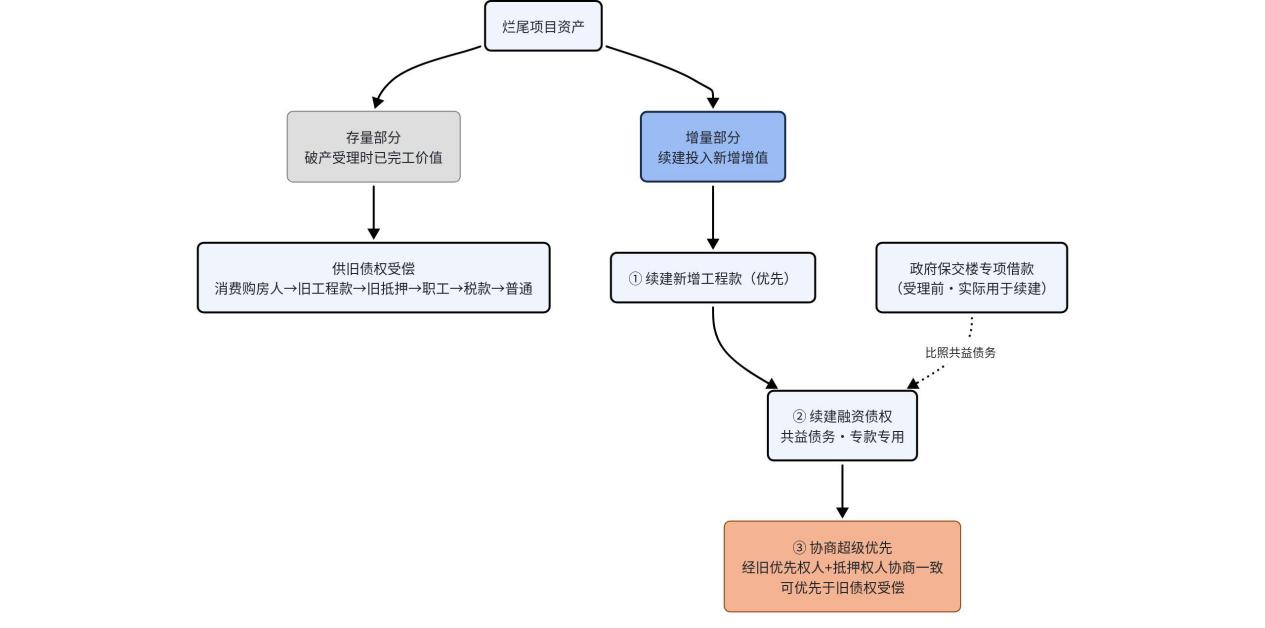
Second, the distinction of the increase in value of the mortgaged property. The original construction project is mortgaged, and the priority claim of the mortgagee is limited to the value of the completed part at the time of bankruptcy acceptance; the new increase in value generated by the continuation investment is separated from the original mortgaged property value. The priority order of the collection of the new increase in value is: the continuation project funds are prioritized over the continuation financing debt.
Third, super priority through negotiation. With the consensus reached by the construction project payment priority claimants and the mortgagee, the ongoing financing claim can take precedence over the old project funds and old mortgage claims before the bankruptcy petition was filed. This is a market-oriented negotiation tool designed by the "Guidelines" to attract new investors - the original guarantors voluntarily relinquish their priority position in exchange for project revitalization and reduction of their own losses.
Fourth, exception for government-led resumption financing. For the resumption loans provided before the bankruptcy petition was filed in accordance with the local government's requirements for ensuring the completion of the project, if the funds are indeed used for the continuation of the project, they can be treated as a general benefit debt. This regulation provides procedural recognition for the historical resumption loan special borrowing, solving the issue of the compensation position of the government's initial investment.
Value segmentation of the existing and the incremental
The value segmentation of the existing and the incremental is the core technical design of the continuation financing system. Its basic principle is: the asset value of the unfinished project is divided into two parts - the existing value of the completed part at the time of bankruptcy petition, and the incremental value added after the continuation investment. The existing value is used to compensate the old claims (old project funds, old mortgage claims, etc.) before the bankruptcy petition, while the incremental value is used to repay the continuation project funds and continuation financing claims.
The significance of this design lies in: the increase in value generated by the new capital investment does not mix with the old mortgaged property, and the old mortgagee cannot "piggyback" and share the new value, thereby ensuring the reasonable return of the continuation investors. At the same time, the priority compensation range of the old mortgagee is limited to the existing value, and their existing guarantee interests are not damaged (the existing value does not decrease due to the continuation) and reduce the resistance of the old creditor to the continuation.
The following figure shows the value segmentation and hierarchical priority mechanism of the existing and the incremental in the continuation financing:
Negotiating the legal boundaries of super-priority
Negotiated super-priority is the most controversial and most necessary rule to clarify the boundaries in the continuation financing system of the "Agreement". It is important to note that this rule does not mean that the court will forcibly deprive the old security creditors of their priority interests; instead, it is achieved through the voluntary relinquishment of priority by the rights holders.
Article 2 of the "Regulations of the Supreme People's Court on Several Issues Concerning the Application of the Enterprise Bankruptcy Law (III)" (Judicial Interpretation [2019] No. 3, revised in 2020) stipulates: After the bankruptcy application is accepted, if the administrator borrows money for the debtor's continued operation and the creditor providing the loan claims that it should be prioritized for repayment over ordinary bankruptcy claims in accordance with Article 42, item 4 of the "Enterprise Bankruptcy Law", the court shall support such claim; however, if the creditor claims to be prioritized over the existing claims that have already secured the debtor's specific property, the court shall not support such claim. This means that under the legal rules, continuation financing debts can only be prioritized over ordinary debts and cannot be prioritized over existing claims that have already secured the debtor's specific property.
The negotiated super-priority rule in the "Agreement" is designed within this legal boundary: For continuation financing debts to obtain a position superior to the old security claims, the old construction project payment priority claimants and old mortgage claimants must negotiate and agree. This is essentially a voluntary decision by the old security claimants to voluntarily dispose of their own priority interests - the old security claimants weigh the "significant depreciation of the collateral when the project is unfinished and the extremely low recovery rate" against "releasing part of the priority to revitalize the project and increase the value of the collateral", and voluntarily make a business decision. The court does not intervene actively and does not forcibly deprive any party of their legal rights.
This legal boundary is of crucial importance: Without the consensus of the old priority claimants, continuation financing debts can only be prioritized over ordinary debts and cannot claim super-priority. In practice, the continuation financing party must ensure that a written priority transfer agreement is reached with the old priority claimants before investing, otherwise its super-priority claim will not be supported by the court.
02 The Cooperation and interest balance of the two systems
The protection of home buyers and continuation financing are not two independent sets of rules, but a closely linked and mutually supporting system combination.
From the perspective of the goal level, both are unified under the ultimate goal of ensuring the completion of housing projects. Continuation financing is a means, and the delivery of houses by home buyers is the purpose. By building and delivering houses through continuation, home buyers do not need to enter the creditor repayment priority order, which is the optimal path. Only when the project does not have the value for continuation, will they take the second-best option, which is to secure their monetary interests through the super-priority position of the consumer home buyer's claim for the return of the project's construction funds.
From the perspective of interest balance, the introduction of continuation financing funds will consume project assets, and the interests of the original mortgage claimants and construction funds creditors will be affected. The "Agreement" uses the value division mechanism to leave the gains from the new investment to the continuation financing claims, without eroding the existing value of the collateral, thereby reducing the resistance of the original creditors. At the same time, although the super-priority right of the consumer home buyer breaks the principle of priority of security rights, its application scope is strictly limited to the self-occupied consumption field, and including mortgage loans in protection is to solve the survival dilemma of home buyers who are "without house and money", which has a legitimate basis.
From the perspective of path selection, there are two paths for ensuring the completion of housing projects in cases of enterprise bankruptcy: Path A (the preferred path) is to approve the continuation plan, introduce continuation financing, resume construction, and deliver to eligible consumer home buyers; Path B (the alternative path) is that the project does not have the value for continuation, declares bankruptcy, the house cannot be delivered, and the consumer home buyer's paid house funds and mortgage loans are first prioritized for repayment. The administrator should assess the feasibility of continuation of the project as soon as the case is accepted, and preferentially choose Path A; only when Path A is not feasible should it transfer to Path B.
03 Comparison of supporting legal provisions
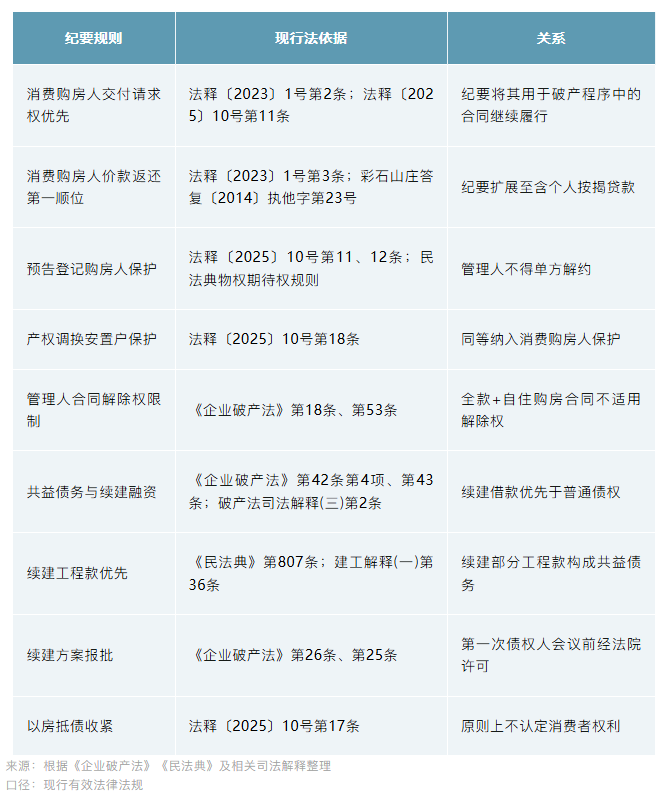
The preservation and settlement rules in the "Regulations" are not mere theoretical constructs; each of the institutional arrangements therein has a legal basis under the current laws. The table below compares the core rules of the "Regulations" with the current laws, judicial interpretations, etc., to clarify their legal basis and institutional positioning:
04 Main Risks and Practical Responses
The preservation and completion rules in the "Regulations" have different impacts on different entities. Each entity should identify the risks based on its own role and adopt corresponding response strategies.
Consumption Homebuyers
Consumption homebuyers are the core protected objects in the "Regulations", but protection does not occur automatically. Homebuyers need to actively claim their rights. Key practical points include: First, properly retain written purchase contracts, payment vouchers (including first payment invoices, bank transfer records, mortgage loan contracts, etc.), online signing and filing certificates, and pre-registration certificates. These are the key evidence for identifying the identity of consumption homebuyers and their payment status; Second, after the real estate developer enters the bankruptcy process, it is necessary to declare the creditor's rights within the debt declaration period to the administrator and clearly assert the identity of consumption homebuyers and the first priority claim right (including mortgage loan part) for price return; Third, when the house is ready for delivery, claim to continue performing the contract, deliver the house, and handle the property certificate; Fourth, pay attention to the progress of project continuation and actively cooperate with the administrator's continuation plan, because the resumption and completion of the project is the optimal path to protect one's own rights.
Non-consumption Homebuyers
Commercial property buyers such as shops and office buildings, as well as investment homebuyers, face greater risks. Their rights do not enjoy super priority and can only be treated as ordinary debts or handled according to the guarantee rules, with a generally lower repayment rate. In practice, it is necessary to declare the creditor's rights as early as possible and verify whether there are any legally valid mortgage guarantees; For those with the right to use the property as debt settlement, it is necessary to focus on verifying whether the basic creditor's rights have priority (such as construction project price priority) and whether the debt settlement price is fair, in order to strive for a better repayment position.
Construction Enterprises (Contractors)
Construction enterprises have a dual identity in the real estate bankruptcy: they are the priority claimants of the existing project funds and the potential creditors of the continued construction additional funds. Key practical points include: First, promptly claim the priority claim of construction project price, pay attention to the exercise period (from the date when the contractor should pay the construction project price until 18 months later); Second, assess the pros and cons of resuming work - if the resumption is agreed, the additional construction funds constitute a common benefit debt that can be paid immediately and through negotiation obtain a super priority position; If the resumption is refused, there may be forced submission of materials, fines, detention, and compensation liability; Third, cooperate with the administrator to fix the completed project quantity at the time of bankruptcy acceptance, to ensure the accurate determination of the amount of existing project funds.
Mortgagee (Financial Institutions)
Mortgagees are one of the entities whose interests are affected the most in the "Regulations". Their priority claim range is cut to the existing value, and the continued construction increase part is allocated to the continued construction creditor. Key practical points include: First, actively participate in the discussion and voting of the continuation plan, assess the feasibility of the project continuation; Second, carefully decide whether to accept the priority transfer - if the project completely collapses, the value of the mortgaged property will be significantly depreciated, the repayment rate may be lower, and negotiating the transfer of priority to obtain project revitalization is often a better choice; Third, in the negotiation for super priority, ensure that the continued construction financing funds are used exclusively for project continuation and set up a fund supervision mechanism to prevent funds from being misappropriated.
Continuation Financing Parties
Continuation financing parties are the incentive objects in the design of the "Regulations", but investment risks still exist. Key practical points include: First, in order to obtain a super priority position, it is necessary to reach a written priority transfer agreement with the old construction project price priority claimants and the old mortgagee; otherwise, it can only be prioritized over ordinary debts; Second, require the funds to be used exclusively for project continuation, accept supervision by the administrator, and ensure that all funds are used for project continuation; Third, conduct thorough due diligence before investment, including the assessment of the existing project value, the calculation of the continued construction cost, and the verification of the amount of old debts, to ensure the feasibility of the investment return; Fourth, pay attention to the court approval process of the continuation plan to ensure the legality of the financing plan.
05 Evaluation and Limitations of the System
The preservation of housing delivery rules in the "Minutes" have significant progressive significance in the design of the system. In terms of protecting home buyers, it has solidified the property rights expectation rights of commercial housing consumers and established a first-priority repayment rule for the creditor's rights of the purchase price (including mortgage loans) in cases where the house cannot be delivered, significantly strengthening the protection of self-occupied home buyers, while strictly limiting the scope of application to prevent the abuse of the system. In terms of continued construction financing, it has broken through the procedural obstacles for the resumption of construction of abandoned projects, through the value division of existing and incremental assets, the channel for common interests debts, and the mechanism for adjusting the negotiation priority, solving the core pain point of "no money to resume construction" for bankrupt abandoned projects, providing institutional incentives for the entry of market-based funds into bankruptcy reorganization projects.
However, the rules in the "Minutes" also have certain limitations. Firstly, as a meeting minutes, its legal effect is lower than laws and judicial interpretations, and it cannot break through the legal framework of the "Enterprise Bankruptcy Law". The super priority rights of consumer home buyers and the negotiation super priority in continued construction financing both have strict application prerequisites and are not unconditional priority. Secondly, the practical effect of the negotiation super priority rule depends on the commercial judgment of the old priority claimants. If the old priority claimants refuse to give up the priority position, the continued construction financing party can only obtain the status of common interest debt, and the attractiveness may be insufficient. Thirdly, the value division of existing and incremental assets in practice has technical difficulties - how to accurately define the completed project quantity and value at the time of bankruptcy acceptance, how to distinguish between existing value and incremental value, requires professional engineering cost assessment, which may cause disputes. Finally, the identification standards for consumer home buyers in the "Minutes" (such as the definition of "self-occupied consumption" and the scope of improvement needs) still need to be further refined in individual cases, and there may be problems of inconsistent judicial standards.
Conclusion
The "Preservation of Completed Properties" rule in the "Minutes of the National Court Conference on Handling Bankruptcy Cases of Real Estate Development Enterprises" is a systematic integration and innovation of the judicial rules for handling corporate bankruptcy cases in the real estate industry by the Supreme People's Court under the background of deep adjustment in the real estate sector. Its core logic is "delivery priority and guarantee for repayment", and it constructs a "rights protection + financial guarantee" dual-wheel-driven system through the super priority rights of consumers purchasing properties and the financing value cutting mechanism for continued construction, providing an operational legal framework for the revitalization of unfinished projects and the protection of the rights of property buyers.
For legal practitioners, the key to understanding the "Minutes" lies not in memorizing specific provisions, but in grasping its institutional logic: Preservation of completed properties is not a simple issue of creditor ranking, but a systematic project involving project revitalization, interest balance, and multi-party negotiation. Only by considering the protection of property buyers and the continuation of financing comprehensively can the unity of legal effect, social effect, and political effect be achieved in corporate bankruptcy cases.
It is particularly important to note that this analysis is based on the "Minutes" text and current laws and regulations, and does not constitute legal opinions for specific cases. The handling of individual cases still requires a comprehensive judgment based on all evidence such as project mortgage status, contract performance, payment vouchers, and real estate registration. It is recommended that relevant parties consult professional bankruptcy lawyers when encountering specific issues.
References and Legal Text Index
1. "Enterprise Bankruptcy Law of the People's Republic of China" (2006) Article 18, Article 25, Article 26, Article 42, Article 43, Article 53, Article 113
2. "Civil Code of the People's Republic of China" (2020) Article 410, Article 414, Article 807
3. "Reply of the Supreme People's Court on the Protection of Consumers' Rights in Real Estate Contracts" (Judicial Interpretation [2023] No. 1), Article 1, Article 2, Article 3
4. "Interpretation of the Supreme People's Court on the Application of the Enterprise Bankruptcy Law" (Judicial Interpretation [2025] No. 10), Article 11, Article 12, Article 13, Article 17, Article 18
5. "Explanation on the Application of Construction Engineering Contract Dispute Cases in the Enterprise Bankruptcy Law" (Judicial Interpretation [2020] No. 25), Article 35, Article 36, Article 40
6. "Provisions of the Supreme People's Court on Several Issues Concerning the Application of the Enterprise Bankruptcy Law" (Judicial Interpretation [2019] No. 3, revised in 2020) Article 2
7. "Reply of the Supreme People's Court to the Request of Shandong Provincial Higher People's Court on the Disposal of Housing Purchase Contract Disputes in Jinan Cai Shi Shuangshan" (〔2014〕Executive Letter No. 23, 24)


